It depends on the route and the starting point
If you are researching the Camino de Santiago de Compostela, this is probably one of the first questions that comes up: how many days do you need? The short answer is that it depends a lot on the route and the starting point you choose. The long answer, with real numbers, is below.
The Camino de Santiago is not one fixed route. Several historic routes lead to Santiago de Compostela, each a different length, and you can also choose to walk a single section rather than the whole route from its historic starting point.
The full route from France: about 30 to 35 days
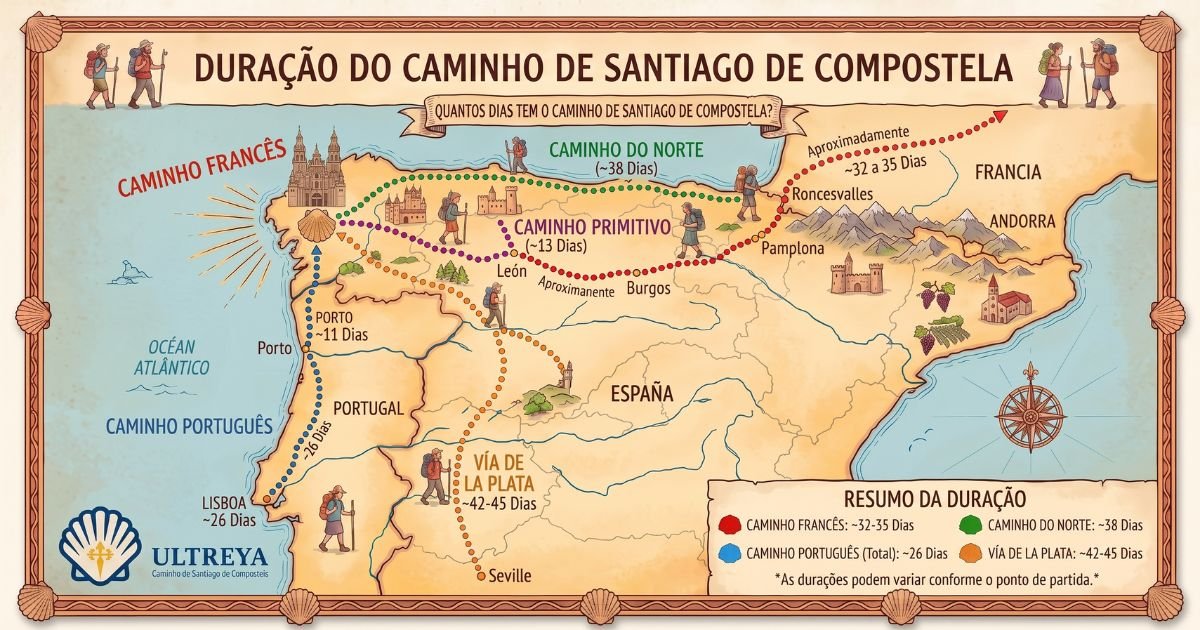
The most traditional route, the Camino Francés, starts in Saint-Jean-Pied-de-Port, in France, and covers about 780 km (485 miles) to Santiago. Walking an average of 20 to 25 km (12 to 16 miles) a day, most pilgrims finish the whole route in 30 to 35 days, not counting extra rest days. You can see this route stage by stage, with a map and the best time of year to walk it, in the complete guide to the Camino Francés.
How many days each route takes
Each historic route has its own length, so the number of days changes a lot depending on which one you choose. Walking an average of 20 to 25 km (12 to 16 miles) a day, these are the usual figures:
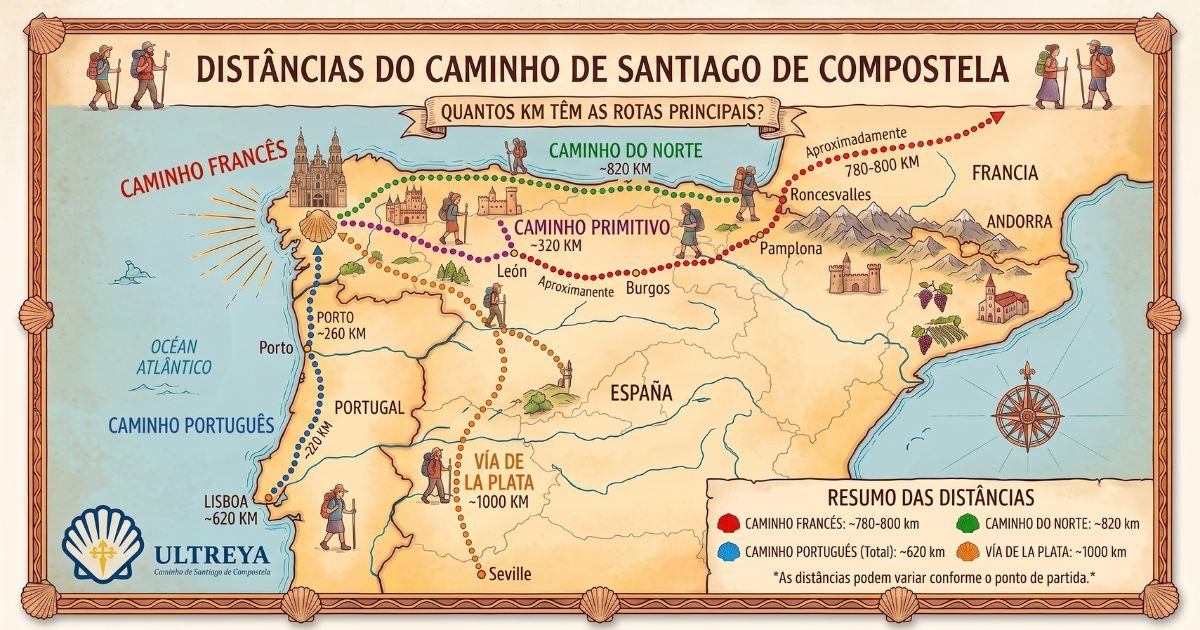
- Camino Francés, from Saint-Jean-Pied-de-Port: 780 km — about 30 to 35 days.
- Camino del Norte, from Irún: 833 km — about 33 to 38 days, the longest of the main routes.
- Camino Portugués Central, from Lisbon: 619 km — about 25 to 28 days.
- Camino Primitivo, from Oviedo: 316 km — about 13 to 15 days.
- Camino Portugués Coastal: 265 km — about 11 to 13 days.
- Camino Portugués, from Porto: about 230 km — around 12 days.
- Camino Inglés, from Ferrol: 122 km — about 5 to 6 days.
- Camino Finisterre, from Santiago to the Atlantic: about 85 km — 4 to 5 days.
These are walking days only. Add your arrival and departure days, plus any rest day you want to build in — see the section further down. For the distances behind these figures, see how many miles the Camino de Santiago is.
“It is not the number of days that makes the pilgrim — it is what happens inside them.”
Shorter alternatives
Not everyone has a full month available, and the good news is that you do not need to walk the entire route to live the experience. Some popular options:
- The last 100 km (62 miles), starting in Sarria: about 5 to 6 days of walking. This is the minimum distance on foot to receive the Compostela, the official pilgrimage certificate.
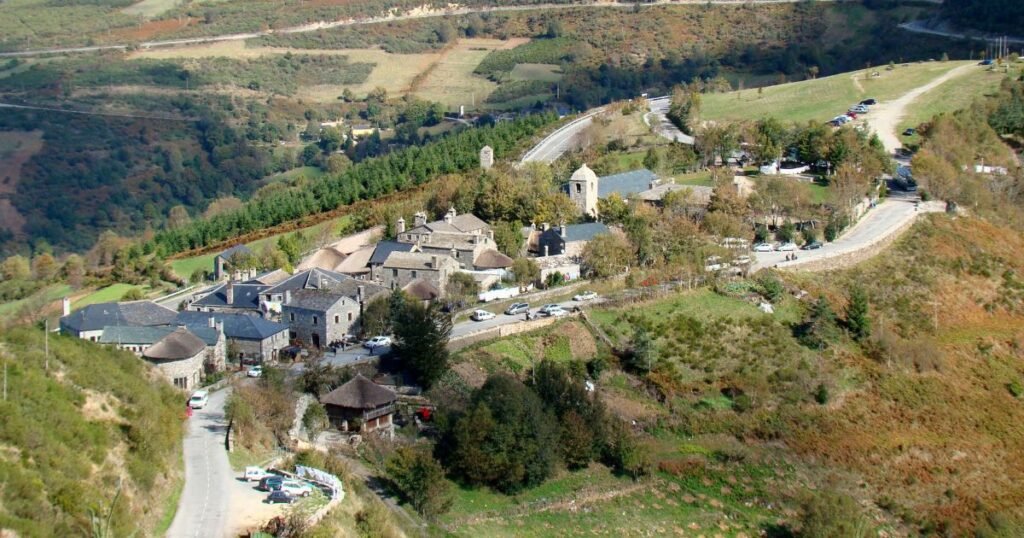
- The final stretch from León or Astorga: between 10 and 15 days, depending on your pace, covering landmark stages such as the Cruz de Ferro and O Cebreiro before reaching Santiago.
- The Camino Portugués, starting in Tui: about 6 days, another popular option for anyone with less time available.
How many days you need to earn the Compostela
To receive the Compostela, the official certificate issued by the Pilgrim’s Office in Santiago, you have to cover at least the last 100 km (62 miles) on foot, or 200 km (124 miles) by bike, with your credential stamped at least twice a day along the way.
In practice that means five to six days of walking. The two most popular starting points are Sarria, on the Camino Francés, and Tui, on the Camino Portugués — both sit just over the 100 km mark. Counting the day you arrive and the day you leave Santiago, a realistic trip is seven to eight days door to door.
How far to walk each day
Most pilgrims walk between 20 and 25 km (12 to 16 miles) a day, a comfortable pace that still leaves time to rest, visit the towns along the way and take care of your feet. Shorter stages of 15 to 18 km (9 to 11 miles) are common on itineraries designed to balance physical effort and comfort.
Rest days, arrival and departure: what to add to the count
The figures above count walking days only. Three things that almost always get left out of a first plan:
- The arrival day. Reaching your starting point, checking in and getting your first stamp usually takes a full day, especially after a transatlantic flight.
- Rest days. On anything longer than two weeks, most pilgrims build in one rest day per week — often in a city worth stopping in, such as Burgos or León.
- The day after you arrive. Very few pilgrims want to reach Obradoiro Square and leave the same afternoon. Keep at least one night in Santiago for the Pilgrim’s Mass and the cathedral.
As a rule of thumb, add two to four days to the walking figure of whichever route you choose.
There is no single answer to how many days the Camino de Santiago de Compostela takes: it can be a week, covering the last 100 km, or more than a month for anyone walking the whole route from France. What matters is choosing the distance that fits the time you have, without giving up the most memorable parts of the Camino.